
News (category: "Ingegneria Informazione")
In accordance with the University Regulations governing the establishment of Excellence Education Programmes for students, the Department of Engineering of the University of Perugia announces a call for applications for admission to the Excellence Education Programme in Clean Energy Transition (PDE-CET).
The PDE-CET is a supplementary educational programme designed for high-achieving students enrolled in Bachelor's or Master's degree programmes at the Department of Engineering. It aims to recognise and foster talent while promoting interdisciplinary learning in the fields of energy transition, sustainability, technological innovation, and applied research.
Programme activities take place alongside students' regular academic studies and do not award additional university credits (ECTS) towards their degree.
For the 2026/2027 Academic Year, 15 places are available.
Applications must be submitted by 12:00 noon (Italian time) by 10 November 2026.
Application documents:
Call (D.D. n. 175 del 09/09/2026) - Attachment A, Attachment B
Course catalogue for the Academic Year 2026/2027 is online.
The catalogue lists the bachelor's degree programs, master's degree programs, and single-cycle master's degree programs activated for the new academic year, along with the admission criteria, administrative deadlines as well as details for enrolment and registration.
The catalogue is available online through the following link.
We kindly inform our prospective students that starting from August 3, 2026, the enrolment procedures for the university's bachelor's degree programs with open access are now open. Enrolment applications shall be submitted by October 20, 2026. The enrolment procedures for master's degree programs are also open, with the final deadline set for March 1, 2027.
The University provides assistance service through an online ticketing service as well as in person guidance both at the Perugia campus (Rectorate building) and at the Terni campus. The service is available Mon-Fri from 9:00 AM to 1:00 PM.
For furthher information please visit: https://www.unipg.it/en/courses/admission
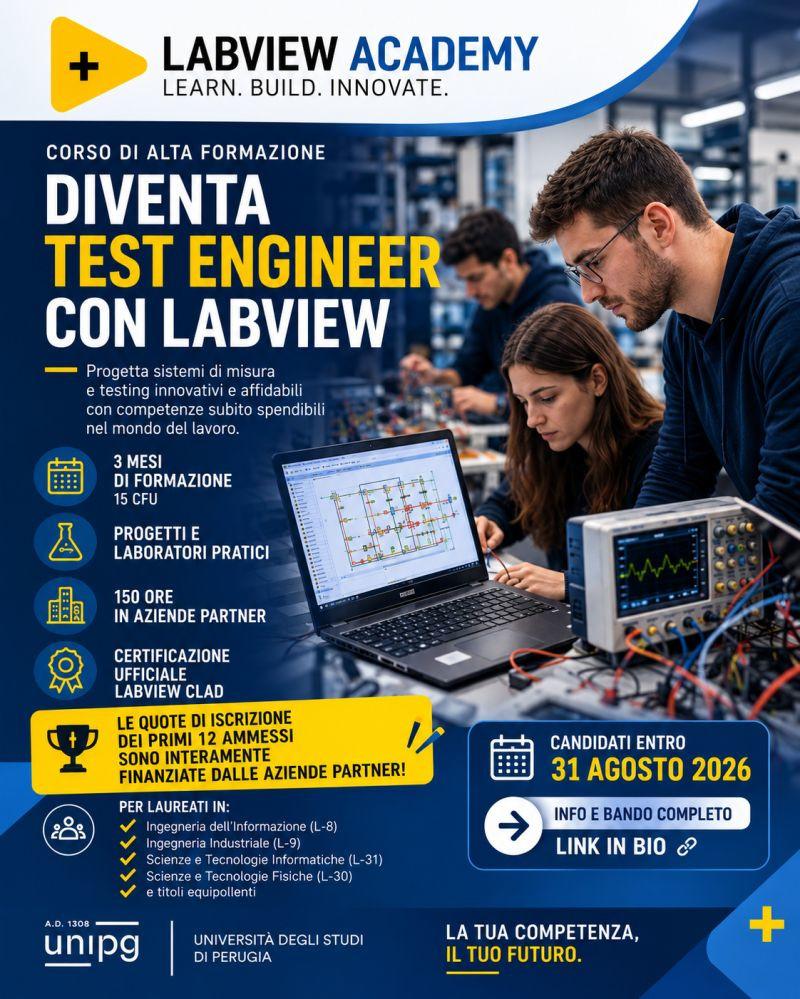
Applications are open for the Advanced Training Course "LabVIEW and Testing Technologies Academy".
The program is designed to train highly qualified professionals in the field of measurement systems, testing, and automation, through an industry-oriented, hands-on approach.
The course includes:
- 3 months of training (15 ECTS) laboratories and applied projects
- 150 hours of activities at partner companies
- Official LabVIEW CLAD certification
We welcome applications from BSc graduates in Information Engineering, Industrial Engineering, Computer Science and Engineering, Physical Sciences and Technologie, or equivalent degrres.
The first twelve students accepted into the course will receive a 100% tuition waiver. The aid is supported by the partner companies - Asterisco Tech, CBL Electronics, EN4, Pragma Engineering Srl, NI (National Instruments).
Deadline for submitting applications: August 31, 2026.
All the details and the complete announcement are available on the University of Perugia's website.
Sono aperte le candidature per il Corso di Perfezionamento di Alta Formazione "LabVIEW and Testing Technologies Academy" dell'Università degli Studi di Perugia.
Tesi magistrale o triennale - "Sviluppo di un software per valutare i benefici energetici e ambientali delle superfici riflettenti"
Relatori: Walter Didimo e Federico Rossi.
Descrizione sintetica
La tesi è rivolta principalmente a studenti del Corso di Laurea Magistrale in Ingegneria Informatica e Robotica o a studenti del Corso di Laurea Triennale in Ingegneria Informatica ed Elettronica (indirizzo informatico). L'obiettivo, con forte natura applicativa, è lo sviluppo di un software per valutare l'efficacia climatica di superfici riflettenti rispetto a superfici tradizionali, stimando al contempo la quantità di CO2 equivalente compensata. Il software acquisirà dati da un opportuno sistema di misura (albedometro) e fornirà moduli per il calcolo, la visualizzazione grafica e l'esportazione dei dati elaborati.
Si veda l'allegato per maggiori dettagli.
Progetto FLOR - acquisizione dati a bassa risoluzione e misure a 1-bit
È disponibile una proposta di tesi triennale o magistrale finalizzata al progetto e alla realizzazione, mediante dispositivi commerciali, di un digital-to-time converter, che trasformi un numero in un intervallo di tempo con accuratezze confrontabili con 0.1 ns, per il campionamento di segnali in modo non uniforme.
Per informazioni contattare: paolo.carbone@unipg.it
075 5853629 – 348 1516439
Relatore: Prof. Antonio Moschitta
Proposte di tesi da sviluppare in collaborazione con l'azienda Orizzonte Sistemi Navali (https://www.orizzontesn.it/):
- Behavioural Simulation of Complex Systems
This thesis focuses on the modelling and simulation of behavioural aspects of complex systems to analyse how system components interact and evolve under different operational scenarios.
The work investigates how behavioural models, developed within a Model‑Based Systems Engineering (MBSE) framework, can be used to simulate system dynamics, emergent behaviours, and interactions across multiple domains.The objective is to support early validation of system behaviour, risk identification, and performance assessment through scenario‑based simulation, contributing to improved design decisions and system understanding throughout the lifecycle.
- SysML v2 and AI for Text to Model Requirements Translation
This thesis investigates the use of Artificial Intelligence, including Large Language Models, to automatically translate natural language system requirements into SysML v2 model artifacts.The work focuses on Text to Model generation, demonstrating how AI tools can interpret textual requirements and produce valid SysML v2 syntax that can be directly imported into modelling environments.
The objective is to enable faster model creation, reduce manual effort, and improve consistency and traceability within the system engineering workflow. -
Integrating Agile Methods with Model-Based Systems Engineering (MBSE)
This thesis explores how agile development principles can be integrated with Model Based Systems Engineering (MBSE) to address the challenges of complex, multidisciplinary system development.
The work investigates how continuous connectivity enabled by the digital thread can support seamless collaboration across domains and stakeholders, ensuring traceability and coherence among requirements, architecture, behaviour, and validation artifacts throughout the system lifecycle.
By leveraging multidomain simulation and mission driven systems engineering, the proposed approach aims to enable iterative design, early validation, and effective interface management.
The objective is to define an integrated agile MBSE methodology that mitigates technical risks and optimizes system performance across the entire product lifecycle. -
Model reuse
- A Framework for Model Reuse in Complex Systems Engineering
Methodologies for Building Reusable System Model Libraries across Multiple Projects
This thesis aims to define a methodology and a supporting framework for model reuse in complex systems, enabling the creation of system model libraries based on abstraction and generalization principles. The proposed approach will allow models to be effectively shared, adapted, and reused across different projects, reducing development effort and improving consistency and scalability. - Learning Based System Model Libraries for Cross Project Reuse
A Machine Learning Framework for Reusing Engineering Models in Complex Systems
This thesis explores a machine learning based approach to reusing system models across different projects.
The proposed methodology exploits existing engineering models as training data, allowing the system to learn reusable structures, interfaces, behaviours, and requirement patterns without relying on predefined generalization rules.
The result should be an enabling system that supports automatic model reuse and adaptation, reducing manual effort, accelerating model creation, and improving consistency across complex system development programs.
- A Framework for Model Reuse in Complex Systems Engineering
Il giorno 4 maggio alle ore 16:30 presso l'Aula Magna di Ingegneria, il Dr. Ricardo Marroquim terra' un seminario dal titolo "From Pixels to Perception: Beyond Napoleon’s White Horse".
Siete tutti invitati a partecipare.
Abstract
"What was the colour of Napoleon’s white horse?" This classic riddle highlights a fundamental challenge in visual computing: we cannot truly define colour without accounting for the entire environment: the scene, the light, and the observer. In this seminar, I will explore the transition from isolating the physical properties of a material to the complex, contextual reality of human-centric visualization.
The presentation traces a research trajectory from the development of innovative, low-cost digitization strategies for Cultural Heritage at CNR-Pisa and in Brazil, to current work at TU Delft on the high-fidelity modelling of material appearance through advanced BRDF and microsurface acquisition. We will examine the perceptual intricacies that arise when moving from pure radiometry to the "human-in-the-loop" challenges of immersive displays. I will then showcase a series of recent human-centric XR-related research such as Social & Infrastructure, Healthcare, and Education.
Bio
Ricardo Marroquim is an Assistant Professor at the Computer Graphics and Visualization Group at TU Delft. His research focuses on the intersection of high-fidelity rendering and immersive human-computer interaction, with a strong emphasis on practical applications in cultural heritage, medicine, and education. https://graphics.tudelft.nl/~marroquim/
EN4 nasce nel 2006 come spin-off accademico dell'Università di Perugia. L'esperienza acquisita nell’ambito della ricerca ha permesso da subito di ottenere un approccio rigoroso e scientifico alle problematiche legate al test.
EN4 sviluppa banchi di prova per industrie automobilistiche, manifatturiere, meccaniche ed elettromeccaniche, sia per applicazioni R&D che per fine linea di produzione.
Seguendo l'intero processo di sviluppo del prodotto, dalla progettazione dell'hardware alla prototipazione su piccola scala, dallo sviluppo del software alla produzione della soluzione finale, EN4 è in grado di personalizzare i propri prodotti per soddisfare al meglio le esigenze del cliente.
Tra le varie applicazioni dei sistemi EN4, possiamo elencare la caratterizzazione meccanica, elettrica e termica di motori elettrici, i test degli attuatori angolari e lineari, la caratterizzazione del flusso di gas nei componenti automobilistici, i test su sistemi powertrain e i test funzionali su elettrodomestici.
Posizione
EN4 è Silver Alliance Partner di National Instruments, leader mondiale nel campo dei sistemi di misura, test e automazione industriale. L’azienda EN4 sta raccogliendo candidature per la posizione di sviluppatore software impegnato nello sviluppo di commesse con particolare riferimento a banchi prova e macchine speciali dedicate ad applicazioni R&D, controllo qualità e collaudo a fine linea.
Il software di gestione del banco prova si occupa tipicamente di controllo di sistemi meccanici, acquisizione dati, report dei risultati.
L’ambiente di sviluppo è LabVIEW e l’hardware utilizzato è National Instruments (principalmente CompactRIO).
Descrizione attività:
- Sviluppo applicazioni in ambiente LabView per Windows, LabView RealTime, LabViewFPGA
- Comprensione documenti di specifica dei requisiti software
- Validazione e debug
- Messa a punto sistemi di controllo
- Analisi risultati
- Supporto remoto cliente
- Collaudo macchina
Profilo
Requisiti minimi:
- Titolo di studio (Laurea specialistica - Ing. Elettronica o dell’informazione, Ing. Meccanica, Fisica) oppure anche IT IS/ITS con spiccato interesse verso la programmazione
- Conoscenza della lingua inglese
- Capacità relazionali e di propensione al lavoro di squadra
- Richiesta disponibilità a trasferte (installazioni, modifiche presso stabilimento cliente…)
Requisiti ottimali:
- Conoscenza sistemi di misura e acquisizione grandezze meccaniche ed elettriche (forza, coppia, portata, temperatura, tensione, corrente,…)
- Conoscenza ambiente LabVIEW
- Certificazione LabVIEW CLAD, CLD
- Buona conoscenza lingua inglese
Contatti
EN4 s.r.l.
Nicola Mariucci
Nicola.mariucci@en4.it
Via Allende, 11 - 06073 - Corciano (PG) - Italia
Mobile: +39 333 6498535 / Tel/Fax: +39 075 5010004
Si comunica che il giorno 19 marzo, come da orario ufficiale (ore 9:30), si terrà la prima lezione dell’insegnamento di ELETTRONICA DIGITALE E MICROCONTROLLORI, tenute dalla Prof.ssa Pisana Placidi.